

Learn wWhat is a ChatGPT Prompt Generator and How Does It Work?, and how prompt engineering helps create better AI prompts for accurate, faster, and smarter ChatGPT responses.
Artificial intelligence has transformed the way people write, learn, code, research, and solve everyday problems. Whether you’re drafting marketing copy, creating lesson plans, writing code, or brainstorming business ideas, chances are you’ve come across OpenAI ChatGPT or another Generative AI tool.
However, many users quickly discover that the quality of an AI’s response depends less on the AI itself and more on the instructions they provide.
This is where a ChatGPT Prompt Generator becomes valuable.
Instead of spending time figuring out the perfect way to ask a question, a prompt generator helps users create clear, structured, and optimized prompts that improve AI Response Quality. Think of it as an intelligent guide that understands both human intent and how a Large Language Model (LLM) processes information.
Rather than typing vague requests like “write an article,” users can generate detailed prompts that specify goals, tone, audience, format, constraints, and expected outcomes.
For beginners, a prompt generator removes the guesswork from interacting with AI. For professionals, it speeds up workflows and improves consistency.
Digital marketers use it to create SEO content, developers use it to generate cleaner code, educators prepare learning materials faster, and business owners automate repetitive tasks without needing advanced technical skills.
The growing popularity of Prompt Engineering has made prompt generators even more relevant. As AI tools become more capable, knowing how to communicate effectively with them has become a valuable skill. Instead of relying on trial and error, users can leverage AI-powered prompt creation to produce more accurate, creative, and useful results.
In this guide, you’ll learn exactly what a ChatGPT Prompt Generator is, how it works behind the scenes, why it matters, and how it helps users unlock the full potential of modern AI systems.
What Is a ChatGPT Prompt Generator?
A ChatGPT Prompt Generator is an AI Prompt Generator designed to create effective prompts for AI models like ChatGPT. Rather than asking users to build complex instructions from scratch, it generates optimized prompts based on the user’s objective.
Imagine you want ChatGPT to write a product description.
A basic request might be:
“Write a product description.”
While this may produce a usable answer, the output often lacks detail, target audience awareness, tone, and formatting.
A prompt generator transforms that simple request into something much more effective:
“Act as an experienced ecommerce copywriter. Write a persuasive 250-word product description for a premium wireless gaming mouse targeting professional gamers. Highlight ergonomic design, RGB lighting, battery life, and ultra-fast response time. Use persuasive language, include bullet points, and end with a compelling call-to-action.”
Notice the difference?
The second prompt provides clear Prompt Instructions, follows a logical Prompt Structure, and defines expectations before the AI begins generating content.
Instead of relying on luck, users receive consistent and relevant outputs because the AI understands the context more clearly.
Why Prompt Generators Are Becoming Essential
Modern AI models are incredibly capable, but they aren’t mind readers.
A Large Language Model (LLM) predicts text based on patterns it learned during training. It doesn’t automatically know your audience, preferred writing style, desired output length, or business goals unless you explicitly tell it.
That’s why prompt quality matters.
Prompt generators bridge the communication gap between humans and AI by organizing information into a format the model understands efficiently.
They help users specify:
- Desired role
- Target audience
- Writing style
- Tone of voice
- Output format
- Goals
- Restrictions
- Context
- Examples
- Expected result
This process dramatically improves Response Accuracy while reducing the number of revisions needed.
Prompt Engineering: The Foundation Behind Prompt Generators
Every high-quality prompt generator is built on the principles of Prompt Engineering.
Prompt engineering is the practice of designing prompts that encourage AI systems to generate better responses.
Instead of asking random questions, prompt engineering focuses on giving AI structured guidance.
For example, an effective prompt often includes:
- The role the AI should play
- The specific task
- Relevant background information
- Formatting requirements
- Success criteria
This systematic approach helps improve AI Output Optimization because the model receives enough information to understand exactly what is expected.
As AI adoption grows, prompt engineering has become an essential skill for marketers, developers, writers, researchers, and business professionals.
The Building Blocks of an Effective Prompt
A good prompt generator doesn’t simply add more words. Instead, it organizes information using proven prompt design principles.
Some of the most important elements include:
Role Prompting
One of the easiest ways to improve AI output is through Role Prompting.
Instead of asking:
Explain SEO.
A better prompt would be:
Act as an experienced SEO consultant with 10 years of experience. Explain SEO to a beginner using simple language and practical examples.
Assigning a role gives the AI a clearer perspective, leading to more focused and relevant responses.
Task-Based Prompts
Every prompt should define a specific objective.
These are known as Task-Based Prompts because they clearly tell the AI what action to perform.
Examples include:
- Write a blog post
- Summarize a report
- Translate text
- Generate code
- Create a marketing strategy
- Draft an email
- Design a lesson plan
The clearer the task, the better the results.
Prompt Variables
Different situations require different information.
That’s why advanced prompt generators include Prompt Variables, allowing users to customize prompts without rewriting everything.
For example:
- Audience
- Industry
- Tone
- Word count
- Language
- Product name
- Target keyword
Instead of creating dozens of separate prompts, users can change a few variables and instantly generate customized instructions.
Prompt Constraints
Sometimes users need AI to avoid certain behaviors.
That’s where Prompt Constraints become useful.
Examples include:
- Maximum 500 words
- Use simple English
- Avoid technical jargon
- Don’t mention competitors
- Include five bullet points
- Write in active voice
Constraints narrow the AI’s focus, making outputs more predictable and useful.
Prompt Instructions
Every prompt should contain clear Prompt Instructions.
Good instructions answer questions like:
- What should the AI do?
- Who is the audience?
- What style should be used?
- What format is expected?
- What information must be included?
The more specific the instructions, the less ambiguity the AI has to resolve.
How Does a ChatGPT Prompt Generator Work?
Although it may seem magical, the process behind a prompt generator follows a logical sequence.
At its core, a prompt generator combines Natural Language Processing (NLP) with modern AI models to transform simple user ideas into detailed prompts.
Here’s how the process typically works.
Step 1: Understanding User Intent
Everything begins with the user’s objective.
For example, someone might type:
“Help me write a LinkedIn post.”
The prompt generator doesn’t stop there.
Using Natural Language Processing (NLP), it analyzes the request and identifies important pieces of information:
- Content type
- Target audience
- Platform
- Purpose
- Tone
- Expected length
Rather than treating the request as plain text, the system extracts meaning and context.
This stage is often referred to as intent recognition.
Step 2: Context-Aware Prompting
Next comes Context-Aware Prompting.
The generator gathers additional details to improve prompt quality.
It may ask questions like:
- Who is your target audience?
- What industry are you in?
- What tone do you prefer?
- Should the post be formal or casual?
- Is the goal engagement or sales?
By collecting this information, the prompt becomes much more precise.
Instead of producing generic content, the AI can create highly relevant responses tailored to the user’s needs.
Step 3: Building the Prompt Structure
Once enough information has been collected, the generator organizes everything into a logical Prompt Structure.
A typical structure might include:
- AI role
- Task
- Background context
- Audience
- Tone
- Formatting
- Constraints
- Expected output
Rather than presenting scattered instructions, everything is arranged in an order that helps the AI process information efficiently.
This structured approach improves consistency and reduces misunderstandings.
Step 4: Prompt Optimization
Before presenting the final prompt, many tools perform Prompt Optimization.
This involves refining wording, removing ambiguity, improving clarity, and ensuring the AI receives complete instructions.
During this stage, the generator may also recommend:
- Better wording
- More specific instructions
- Improved formatting
- Additional context
- Clearer success criteria
This optimization significantly improves the likelihood of receiving high-quality responses on the first attempt.
Step 5: Generating Better AI Responses
Finally, the optimized prompt is sent to OpenAI ChatGPT or another AI model.
Because the prompt contains detailed context, structured instructions, defined objectives, and clear expectations, the AI can generate responses that are:
- More accurate
- Better organized
- Easier to edit
- More relevant
- More useful
Instead of repeatedly rewriting prompts through trial and error, users receive higher-quality outputs from the very beginning.
Key Components of a Modern ChatGPT Prompt Generator
Not all prompt generators are created equal. While basic tools simply rewrite your request, advanced platforms intelligently structure prompts using proven Prompt Engineering Techniques. They guide users through a systematic process that improves clarity, reduces ambiguity, and maximizes the performance of OpenAI ChatGPT and other Large Language Models (LLMs).
Below are the essential components you’ll find in a high-quality prompt generator.
1. Prompt Templates
One of the biggest advantages of a prompt generator is access to ready-made Prompt Templates.
Instead of starting from a blank page every time, users can choose a template designed for a specific purpose. Whether you’re writing a blog post, generating code, creating a business proposal, or drafting an email, templates provide a strong starting point.
For example:
Content Writing Template
Act as an experienced content strategist. Write a 1,500-word SEO-friendly article about [Topic]. Include an engaging introduction, H2 and H3 headings, practical examples, FAQs, and a compelling conclusion.
Marketing Template
Act as a senior digital marketing consultant. Create a Facebook advertising campaign targeting small business owners interested in AI automation.
Templates reduce repetitive work and ensure consistency across projects. Businesses often create standardized templates for recurring tasks, saving both time and effort.
2. Prompt Builder
Many advanced tools include a visual Prompt Builder that helps users assemble prompts step by step.
Rather than typing everything manually, users fill out fields such as:
- Objective
- Target audience
- Writing style
- Desired tone
- Word count
- Output format
- Language
- Platform
- Additional instructions
The builder then combines these inputs into a polished, AI-ready prompt.
This approach is especially helpful for beginners who may not yet understand prompt design principles.
3. Prompt Library
As organizations begin using AI daily, they often accumulate hundreds of successful prompts.
Instead of recreating them repeatedly, many companies maintain a centralized Prompt Library.
A prompt library may include prompts for:
- Blog writing
- Email marketing
- SEO
- Product descriptions
- Customer support
- HR documentation
- Coding
- Data analysis
- Sales outreach
- Social media
Having an organized prompt repository improves Prompt Reusability, allowing teams to reuse and refine prompts over time rather than reinventing them.
For example, a marketing agency might maintain separate prompt folders for different clients, ensuring brand consistency while reducing manual effort.
4. Prompt Framework
Professional prompt engineers rarely write prompts randomly. Instead, they follow a repeatable Prompt Framework.
A framework acts like a blueprint that organizes information logically.
A common framework might look like this:
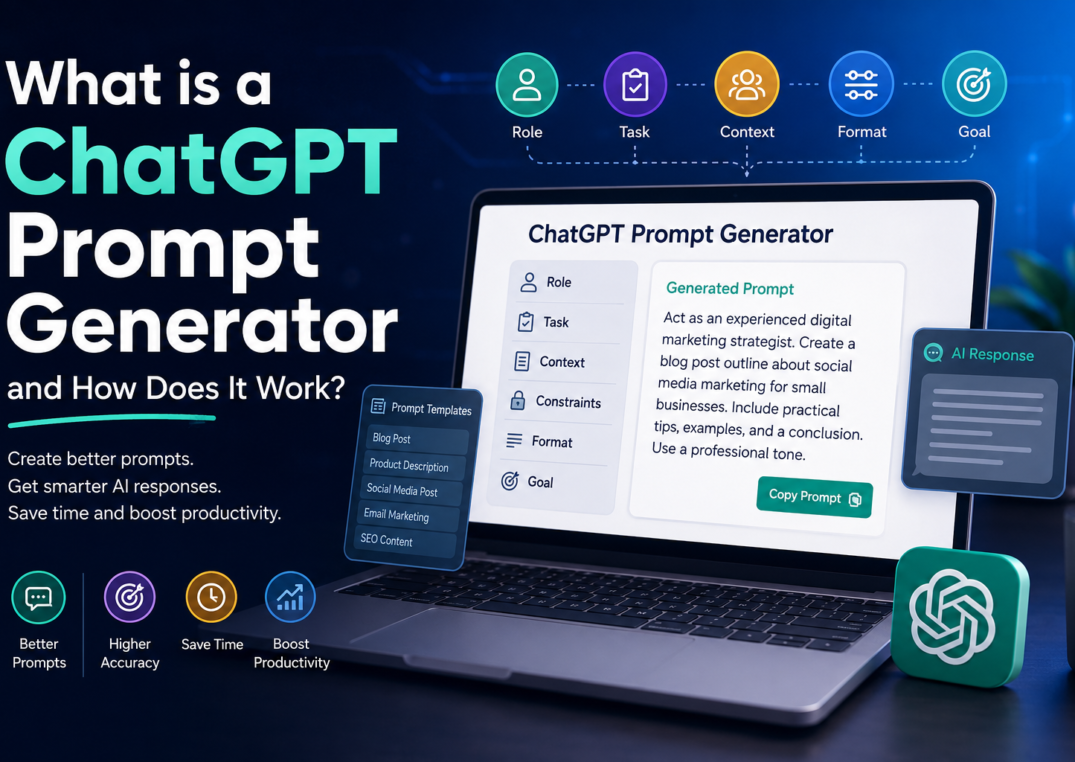
Role → Task → Context → Constraints → Format → Goal
For example:
Role: You are an experienced financial advisor.
Task: Explain mutual funds.
Context: The audience consists of beginners in India.
Constraints: Avoid technical jargon.
Format: Use headings, bullet points, and examples.
Goal: Help readers understand the basics in under five minutes.
Using a consistent framework makes prompts easier to write, edit, and scale across different projects.
Understanding System Prompt vs User Prompt
One concept that often confuses beginners is the difference between a System Prompt and a User Prompt.
Although both influence AI behavior, they serve different purposes.
What Is a System Prompt?
A System Prompt provides high-level instructions that define how the AI should behave throughout the conversation.
It sets the personality, expertise, communication style, and general rules.
Examples include:
- You are an experienced software engineer.
- Always explain concepts in simple language.
- Never provide medical advice without recommending professional consultation.
- Write using a professional tone.
System prompts usually remain hidden from end users but significantly influence the model’s behavior.
What Is a User Prompt?
A User Prompt is the direct request submitted by the user.
Examples include:
- Write a blog post about electric vehicles.
- Summarize this research paper.
- Translate this paragraph into Spanish.
- Explain blockchain to a teenager.
The AI combines the system prompt with the user prompt to generate its final response.
Understanding this distinction helps users appreciate why AI sometimes behaves differently across platforms, even when given the same request.
Advanced Prompting Techniques
One of the reasons modern AI Prompt Generators are so effective is that they incorporate sophisticated prompting strategies behind the scenes.
Let’s look at the most important ones.
Zero-Shot Prompting
Zero-Shot Prompting means asking the AI to perform a task without providing examples.
Example:
Write an email requesting a refund.
The AI relies entirely on its pre-trained knowledge.
Zero-shot prompting works well for straightforward tasks like:
- Definitions
- Summaries
- Explanations
- Simple emails
- Basic coding
- General writing
Because no examples are provided, it’s quick and efficient for everyday use.
Few-Shot Prompting
For more complex tasks, Few-Shot Prompting often produces better results.
Instead of simply giving instructions, users also provide one or more examples.
For example:
Example 1:
Input: Happy birthday message
Output: Wishing you a wonderful birthday filled with happiness and success!
Example 2:
Input: Congratulations on promotion
Output: Congratulations on your well-deserved promotion. Wishing you continued success in your new role.
Now write a congratulatory message for a graduation ceremony.
By learning from the examples, the AI better understands the desired style, tone, and formatting.
This technique is widely used in:
- Brand copywriting
- Customer support
- Translation
- Coding
- Data classification
Chain-of-Thought Prompting
One of the most powerful prompt engineering methods is Chain-of-Thought Prompting.
Instead of asking only for the final answer, users encourage the AI to reason through the problem step by step.
For example:
Instead of asking:
Calculate the profit margin.
You could ask:
Calculate the profit margin and explain each calculation step before giving the final answer.
This technique is particularly useful for:
- Mathematics
- Financial analysis
- Programming
- Research
- Logical reasoning
- Business planning
By breaking down complex problems into intermediate reasoning steps, AI often produces more accurate and transparent responses.
Why Prompt Refinement Matters
Even experienced AI users rarely write the perfect prompt on their first attempt.
That’s why Prompt Refinement is an essential part of effective AI usage.
Suppose your initial prompt is:
Write an article about digital marketing.
The output may be generic.
After refinement, it becomes:
Act as an experienced digital marketing consultant. Write a 2,000-word beginner-friendly guide explaining digital marketing for Indian small businesses. Include SEO, PPC, social media marketing, email marketing, practical examples, FAQs, and actionable tips.
The difference is dramatic.
Prompt refinement involves improving:
- Specificity
- Context
- Audience definition
- Constraints
- Formatting
- Expected outcome
Each refinement helps the AI understand exactly what you need.
Prompt Iteration: Improving Results Over Time
Closely related to refinement is Prompt Iteration.
Rather than expecting perfection immediately, experienced users gradually improve prompts based on previous outputs.
For example:
Version 1
Write a product description.
↓
Version 2
Write a persuasive product description for wireless earbuds.
↓
Version 3
Write a 250-word Shopify product description for premium wireless earbuds targeting fitness enthusiasts. Include key features, benefits, bullet points, emotional language, SEO keywords, and a call to action.
Each iteration removes ambiguity and produces better results.
Over time, organizations often develop high-performing prompts that become reusable assets within their Prompt Library.
Designing Prompts for Better AI Content Generation
One of the most common applications of prompt generators is AI Content Generation.
Content creators, bloggers, marketers, and businesses rely on AI to produce:
- Blog posts
- Landing pages
- Product descriptions
- Social media captions
- Video scripts
- Email newsletters
- Case studies
- Website copy
However, content quality depends heavily on prompt quality.
A well-designed prompt includes:
- Clear objectives
- Defined audience
- Desired tone
- Target keyword
- Content length
- Formatting preferences
- SEO requirements
The result is content that requires less editing and aligns more closely with business goals.
The Importance of Semantic Prompt Design
Many beginners focus only on adding more words to a prompt.
Professional users prioritize Semantic Prompt Design.
Semantic design means writing prompts that clearly communicate meaning rather than simply increasing length.
For example, instead of saying:
Write about coffee.
A semantically rich prompt might say:
Explain the health benefits of Arabica coffee for office workers. Compare Arabica and Robusta beans, include scientific findings, brewing methods, and practical buying tips.
The second prompt gives the AI far more meaningful context, resulting in richer, more relevant output.
Semantic prompting also aligns well with modern SEO practices, where search engines prioritize comprehensive, intent-driven content.