Are you looking for What is a Prompt Library and how it helps ai productivity?
Artificial intelligence (AI) has transformed the way businesses and creators work, enabling faster decision-making, smarter workflows, and innovative solutions. But even the most advanced AI models need guidance to deliver accurate, relevant, and creative outputs. This is where a prompt library comes into play. A prompt library is essentially a curated collection of prompts designed to maximize AI efficiency and improve output quality. From content creation to enterprise-level automation, understanding and leveraging a prompt library can significantly enhance AI productivity.
In this article, we’ll explore the concept of prompt libraries, how they work, and why they are essential for organizations and individual users looking to streamline their AI-driven processes.
Understanding the Basics of a Prompt Library
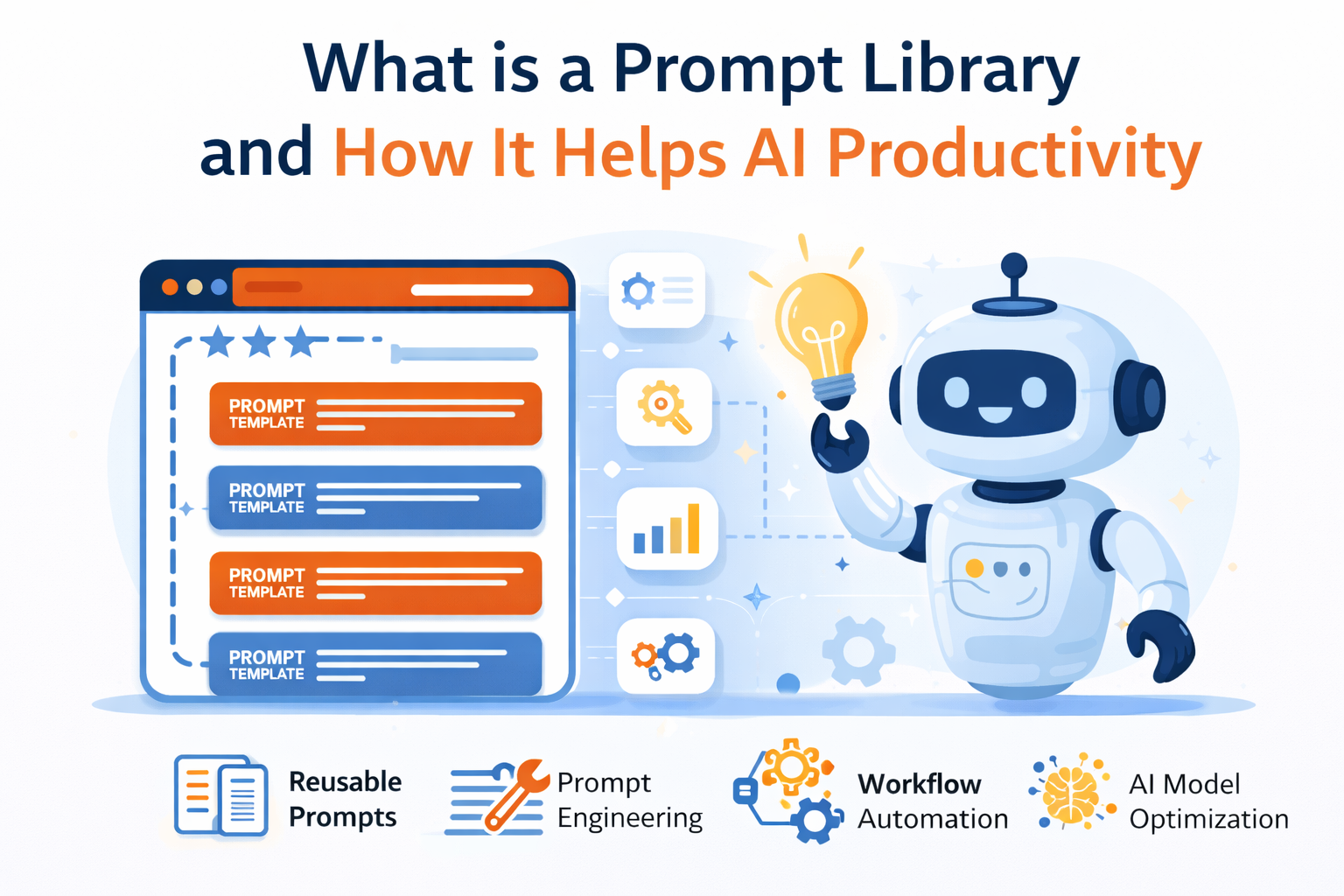
At its core, a prompt library serves as a centralized resource where prompt templates and reusable prompts are stored and organized for easy access. Think of it as a toolkit for your AI models — whether you are working with ChatGPT, Claude, or other generative AI platforms.
By maintaining a structured collection, users can avoid starting from scratch for every task and ensure that AI outputs remain consistent and reliable.
Prompt engineering is a key concept here. It involves designing prompts in a way that guides AI models toward producing the desired output. Through careful crafting, prompts can be optimized to improve clarity, specificity, and creativity.
For example, using few-shot prompting allows you to show the AI a few examples of the expected output, which can dramatically improve the model’s understanding of the task. Similarly, chain-of-thought prompting encourages the AI to reason step by step, resulting in more accurate and logical outputs.
By combining these strategies in a prompt library, users can enhance AI model optimization, ensure consistent output quality, and reduce the time spent iterating on prompts manually.
How Prompt Libraries Improve AI Productivity
One of the most significant benefits of a prompt library is its impact on AI productivity. Here’s how it works in practical scenarios:
1. Streamlined Workflow Automation
By organizing task-specific prompts and standardizing workflow automation, a prompt library allows teams to execute repetitive tasks efficiently.
For instance, marketing teams can create a set of reusable prompts for social media posts, blog outlines, and email campaigns.
Developers can use prompt templates for code generation or debugging tasks. The result is faster project completion and reduced cognitive load, allowing human workers to focus on higher-level decision-making.
2. Enhanced Knowledge Management
A well-structured shared prompt repository becomes a powerful tool for knowledge management. Organizations can store optimized prompts, version histories, and evaluation notes in a centralized location.
Prompt versioning ensures that teams can track changes, test different iterations, and roll back to previous versions when necessary.
By implementing prompt evaluation metrics, teams can monitor the performance of their prompts, identify areas for improvement, and continuously refine their approach.
For example, a customer support team could maintain a library of prompts for AI chatbots. By tracking which prompts generate accurate and helpful responses, they can update the repository, share best practices, and train new team members efficiently.
3. Collaboration Across Teams
Modern AI tools often involve multiple stakeholders, from data scientists to content creators. A collaborative AI tool integrated with a prompt library fosters teamwork and knowledge sharing.
Team members can contribute new prompts, categorize them based on use cases, and standardize them for consistent output. With prompt standardization, everyone in the organization benefits from a shared understanding of how to interact with AI models effectively.
Optimizing Prompts for Maximum Impact
Creating a prompt library is just the first step. To truly enhance AI productivity, organizations must focus on prompt optimization. This includes several strategies:
-
Context-aware prompts: Ensure that prompts include sufficient context so AI models understand the task fully.
-
For example, instead of asking, “Write a blog post,” provide context such as, “Write a 500-word blog post on the benefits of using prompt libraries for AI productivity, targeting small business owners.”
-
Generative AI best practices: Leverage the capabilities of generative AI to experiment with creativity.
-
For instance, using chain-of-thought prompting can help the AI produce structured content that is easier to edit and publish.
-
Task-specific prompts: Different tasks require different approaches. Marketing copy, technical documentation, or data analysis reports each benefit from customized prompt templates.
-
Prompt categorization: Organize prompts by task type, audience, or output format. Categorization makes it easier to find the right prompt quickly and encourages consistency in outputs.
-
Few-shot prompting: Include examples in your prompts to teach AI models the expected style, tone, or format. This is especially effective when working with complex or specialized content.
By applying these strategies within a prompt library, teams can significantly enhance AI model optimization and maintain high-quality results across all projects.
Real-World Applications of Prompt Libraries
Prompt libraries are not just theoretical tools; they have tangible benefits in multiple domains:
-
Content creation: Writers use reusable prompts to generate blog posts, social media updates, and video scripts. By leveraging prompt templates, content creation becomes faster and more consistent.
-
Enterprise AI solutions: Large organizations implement prompt libraries to automate reporting, customer support, and internal knowledge workflows.
-
Using shared prompt repositories and prompt versioning, companies can maintain a high standard of output across departments.
-
Collaborative AI projects: Teams working on research or product development can benefit from a shared library where everyone contributes, reviews, and categorizes prompts, ensuring that best practices are maintained.
-
Generative AI innovations: Designers, marketers, and developers use prompt libraries to explore creative outputs, such as generating visuals, writing code snippets, or even prototyping new business ideas.
By embedding prompt libraries into daily workflows, organizations can unlock the full potential of AI while reducing repetitive work and improving overall productivity.
Conclusion: What is a Prompt Library
A prompt library is more than just a collection of prompts — it’s a strategic tool that empowers teams to enhance AI productivity, streamline workflows, and foster collaboration.
From reusable prompts and prompt templates to advanced strategies like few-shot prompting, chain-of-thought prompting, and context-aware prompts, a well-maintained library ensures that AI models deliver consistent, accurate, and high-quality outputs.
Organizations that implement prompt versioning, prompt evaluation metrics, and prompt standardization gain a competitive edge, while individual creators can save time and enhance creativity.
By integrating task-specific prompts, maintaining a shared prompt repository, and applying best practices in prompt engineering, you can fully leverage AI’s capabilities in your workflows.
If you’re looking to boost productivity, improve AI outputs, and create a centralized knowledge resource, starting your own prompt library today is a smart move. Explore, organize, and optimize your prompts — your AI models will thank you.